Deals Down So Far in 2017
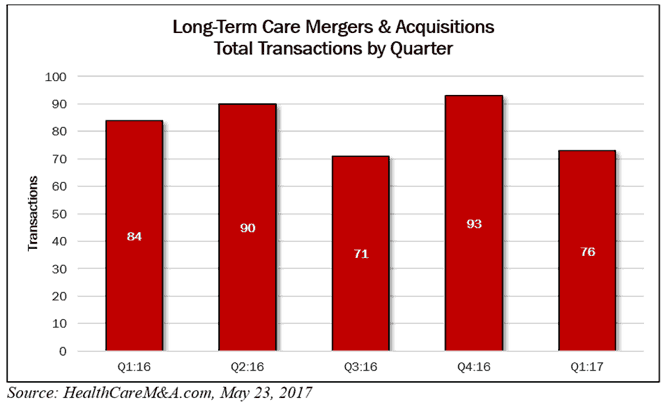
Long-term care has experienced a dip in M&A, but after nearly three straight years of 80+ transactions per quarter (starting in Q3:2014 with 83), with a couple exceptions, it is about time the M&A juggernaut slows down a bit. The first quarter’s volume fell to 76 deals, down from 93 in the previous quarter and from 84 in the year-ago quarter. And as of May 23, 2017, deal volume has so far not kept pace compared with the same period in 2016 with just 118 long-term care transactions recorded compared with 145 in 2016, a 19% difference. However, spending has nearly doubled (to $7.52 billion so far in 2017 from $4.37 billion in 2016), thanks to a few large deals that were announced in... Read More »
Expense Ratios: Independent Living Vs. Assisted Living
When comparing the independent living and assisted living markets, one would expect IL communities to operate at a higher margin than AL, given its lower services and thus, costs. And while that remained true in 2016, independent living and assisted living expense ratios came as close to equal as any time in the past, at 69.5% and 72.5%, respectively, according to the 22nd Edition of The Senior Care Acquisition Report. Only in 2011, when independent living had a higher expense ratio than assisted living, by just 10 basis points, did the two sectors operate more similarly. The shift has been steady, with the spread between IL and AL expense ratios of properties sold sharply decreasing from... Read More »Expensive Seniors Housing Sales With Low Expense Ratios
It’s no surprise that as a community’s expense ratio declines, its value increases. As such, there was a near-perfect correlation between the expense ratio and the average price per unit paid in the seniors housing market in 2016 (including independent living and assisted living communities), according to the The Senior Care Acquisition Report. The best-operating communities with expense ratios under 65% were valued on average at $298,100 per unit, way up from the $256,100 per unit recorded in 2015. Both years were still heavily influenced by high-quality independent living sales. Meanwhile, the grouping with a 65% to 69% expense ratio fell in value year over year, from $193,000 per unit... Read More »
New Senior Care M&A Data
Assisted living per-unit prices rise for the latest four quarters, while skilled nursing remains the same. It was a relatively slow first quarter with regard to publicly announced seniors housing and care acquisitions, other than some old large deals announced last year that finally closed in the quarter. On a rolling four quarters basis, the average price for assisted living jumped to $210,300 per unit for the period ended March 31, compared with $193,650 per unit for calendar year 2016. The average cap rate remained at 8.5% but with an obvious wide range. Meanwhile, independent living did the reverse, dropping to $208,900 per unit for the four quarters ended March 31 compared with... Read More »Sizing Up the Seniors Housing Market
In 2016, buyers paid up for larger seniors housing communities (including independent living and assisted living) compared to 2015. We observed in the 22nd Edition of The Senior Care Acquisition Report that once again, the largest properties, with 150 units or more, still beat out smaller properties in price, averaging $226,200 per unit, 16% higher than 2015’s $195,600 per unit. Here is where the high-priced independent living communities that sold in 2016 exerted their influence in the overall market, representing a clear majority of the largest properties and pushing up the price. Communities with between 100 and 149 units came with a lower price than 50- to 99-unit communities,... Read More »Schedule a demo
Gain access to the best healthcare and long-term care investment intelligence, data, and analysis.